
From System Failure to Legal Exposure: The Liability the NSW Government Can No Longer Ignore
- Editor

- Nov 4, 2025
- 4 min read
Updated: Feb 19
For more than a decade, NSW has not simply struggled to manage its workers’ compensation system it has administered a foreseeable harm event at scale.

This is no longer a debate about “reform”, “efficiency”, or “sustainability”. It is long past that. It is now a question of legal, financial and moral liability.
And the evidence is no longer technical or abstract. It is structural, documented, and cumulative.
1. The State knew the workers' compensation system was broken
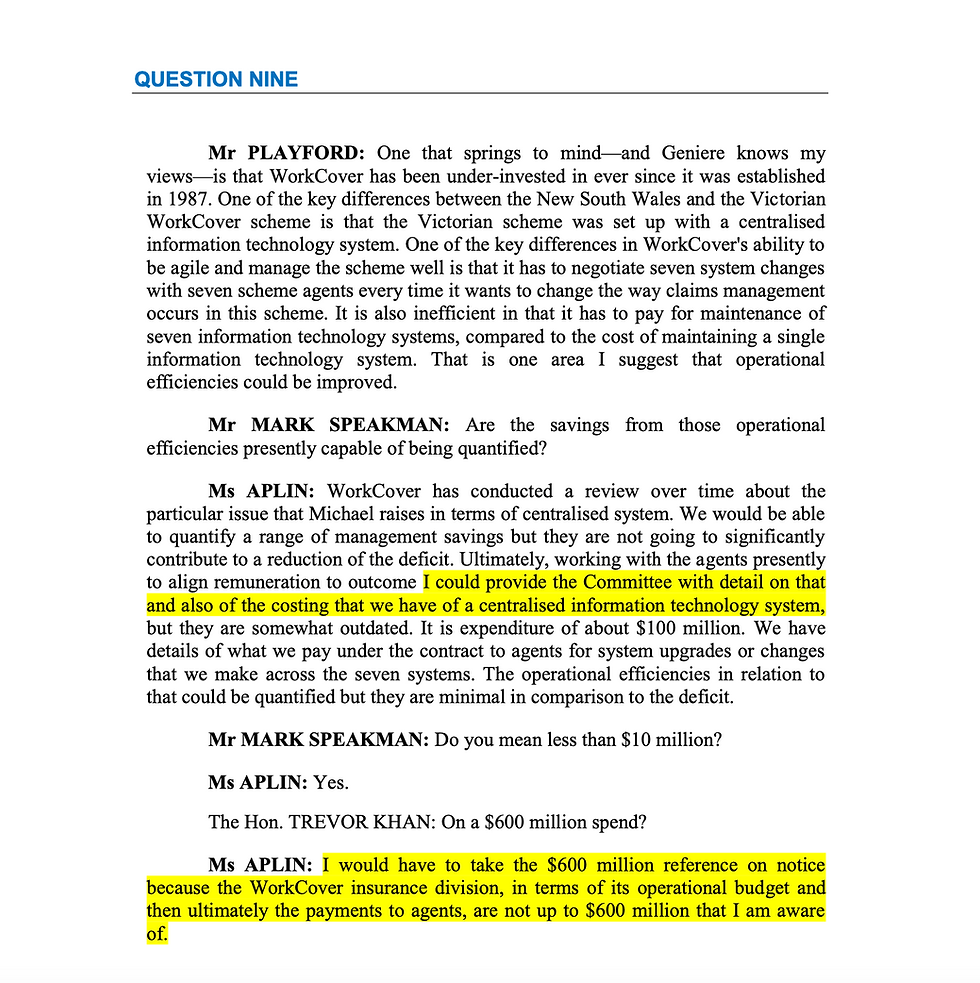
In 2014, evidence given to the NSW Parliament confirmed that the former WorkCover NSW responsible for millions workers was operating seven incompatible IT systems to manage claims and injury outcomes.
Seven systems. Seven databases. Seven versions of the truth.
Ten years ago - No hospital, no bank, no public health system would be allowed to operate on that foundation.
In 2025, to think that the lives of injured, vulnerable people were being managed on seven incompatible IT systems shocks us all to the core. It is after all about human health.
Yet on that foundation, NSW built its “modernised” workers’ compensation regime.
“WorkCover NSW was operating on seven separate IT systems in 2014, unlike Victoria which had one unified platform.”

2. The decision that created systemic liability
Rather than fix the core system underlying all of this, in 2015 the Government dismantled WorkCover and split it into three separate agencies and started one IT Tech Platform Build for icare, later subject to significant media coverage. See above RSM Australia Probity Review (2021).
Function | Agency | Status |
Insurance & claims | icare | Guidewire platform, remediation ongoing |
Regulation & outcome data | SIRA | Still building analytics capacity |
Workplace safety | SafeWork NSW | Running 20-year-old core system until 2024 |
No shared database. No single source of truth. No whole-of-system recovery tracking.
That design decision knowingly embedded fragmentation, data instability and outcome blindness into the statutory scheme.
3. Foreseeable harm — now confirmed in official records
Independent oversight bodies have now documented the consequences. But the technological failures underpinning that harm and their impact on real human lives — have never been fully investigated, despite years of warnings from the injured themselves.
A Summary
NSW Auditor-General (2024): icare “has not focused enough on improving return-to-work outcomes”
SafeWork Audit (2024): IT system over 20 years old, “not reliable” for high-risk workplace identification
SIRA oversight reports (2023–25): no verified recovery baseline for psychological injury
Multiple inquiries (2016–25): delays, denials, deterioration, secondary psychological harm
This is no longer anecdotal. It is now recorded in the administrative archive of the State.
4. The legal position has shifted
To meet the threshold for class action or redress, five elements must exist:
Test | Status in NSW workers’ comp |
Duty of care | ✅ statutory, undisputed |
Breach | ✅ documented in audits & inquiries |
Foreseeability | ✅ harm known since at least 2012–14 |
Loss / injury | ✅ financial, medical, psychological, suicidal harm |
Continuation after knowledge | ✅ failure persisted through multiple reforms |
This is why legal exposure now exists at the system level, not the individual claim level.
5. Who has been harmed?
This is not limited to psychological-injury claimants.
The potentially affected class includes:
workers whose physical injuries deteriorated due to delays
workers re-injured by the claims process itself
workers who lost income or treatment because of administrative failure
families affected by suicide linked to claim process stress
and employers who were charged premiums based on unreliable data
The harm is widespread, documented, and traceable.
Employer impact — the other victims of system design
Employers were required by law to fund a statutory scheme that:
miscalculated premiums
failed to deliver stable return-to-work outcomes
diverted funds to IT remediation and system rebuilds
exposed them to reputational and legal risk
blamed “cost blowouts” on injured workers instead of failed system design
The time to fix this system was in 2012 when the Government already knew it was running workers’ compensation on seven incompatible IT systems.
They didn’t fix the harm. They deferred the cost.
6. Redress Is Not An Option
If this were aged care, veterans’ care, or banking, the response would already be in motion:
Redress scheme
Independent audit of harm
Public apology
Systemic compensation pathway
That is now the standard injured workers are entitled to expect.
The only question is whether it will be offered voluntarily or forced through litigation.
7. Systemic Failure
This was not a system that “broke over time”.
It was designed on fractured infrastructure, maintained with inconsistent data and then scaled, automated without audit, and defended through narrative rather than evidence.
They didn’t just leave vulnerable people in a burning house. They rebuilt the house, lit it again and called it reform.
Sources
NSW Parliament 2014 WorkCover evidence (7 IT systems) (direct reference – link to PDF / tabled record) QON
NSW Audit Office, Workers compensation claims management (icare & SIRA) — April 2024: https://www.audit.nsw.gov.au/our-work/reports/workers-compensation-claims-management audit.nsw.gov.au+1
Insurance Council of Australia + CSIRO, AI for Better Insurance: Enhancing Customer Outcomes amid Industry Challenges — August 2025: https://www.csiro.au/-/media/D61/Reports/AI-for-insurance/25-00074_D61_REPORT_ICA-AIForBetterInsurance_PRINT_250818.pdf CSIRO
SIRA, Claims Management Review – Performance review of insurer claims management in NSW Workers Compensation Scheme — September 2025: https://www.sira.nsw.gov.au/resources-library/regulation-and-fraud/claims-management-review sira.nsw.gov.au+1
NSW Parliament Inquiry, Workers Compensation Legislation Amendment Bill 2025 – Report No 5 — November 2025: https://www.parliament.nsw.gov.au/lcdocs/inquiries/3108/Report%20No%205%20-%20PAWC%20-%20Workers%20Compensation%20-%20FINAL.pdf
(All sources are public, official, or tabled. No allegation of individual misconduct is made.)
Legal Note
This post summarises publicly available information and draws policy inferences in the public interest. It alleges no individual wrongdoing and makes no claim about specific cases. It addresses system design, not personal fault.


Comments