
Beyond the blast furnace: remembrance in Lithgow

You may miss the sound effect but it is there if you listen: The church bells heard briefly in Episode 1 of Shattered connect us to a history of industry, family loss and memorial gardens.
In Episode 1 of Shattered: Origins of Control, you can hear the bells of Hoskins Memorial Church in Lithgow. Behind that sound is a story of family loss and remembrance that extends beyond the film.
The church gardens are in full bloom at the moment. Their history connects a family prominent in Australia’s steel industry with a landscape gardener whose own children would later be commemorated in the grounds.
From the blast furnace to the church gardens
Lithgow is where the investigation in Shattered begins. Its industrial history provides a starting point for exploring work, injury and the development of systems intended to protect workers and their families.
The blast furnace remains a visible reminder of that history. The Hoskins family helped develop Lithgow’s iron and steel enterprise before operations moved to Port Kembla under Charles Hoskins’ sons, Cecil and Sidney. Australian Iron & Steel was formed in 1928 and became part of BHP in 1935.
The church offers another perspective on this family’s place in Lithgow.
Charles Hoskins began the church project following the deaths of his son Guildford and daughters Hilda and Nellie. Neither Charles nor his wife Emily lived to see it open in 1928. Its stained-glass windows commemorate these family losses, as detailed in Lithgow City Council’s history of the church.
The Hoskins name on the church is therefore an expression of remembrance as well as a connection to the town’s industrial past.
Paul Sorensen and the Hoskins family
The gardens bring another significant person into this story. Danish-born landscape gardener Paul Sorensen arrived in Australia in 1915 and eventually established his home and nursery in Leura. Known in the Blue Mountains for his work at Everglades, he helped create around a hundred gardens throughout New South Wales.
His designs used trees, stone walls, paths and changes of level to shape spaces. He often worked directly on site with owners and workers, rather than producing detailed plans.
In Paul Sorensen in the Southern Highlands and Illawarra, garden historian Stuart Read argues that Sorensen deserves recognition among Australia’s finest landscape designers of the twentieth century. Read suggests that his limited written records and plans contributed to his receiving less attention than contemporaries such as Edna Walling and Walter Burley Griffin.
Cecil Hoskins was impressed by Sorensen’s work at Everglades. Their professional relationship developed into a lasting friendship, leading to commissions for the Hoskins family’s homes, company grounds and community projects.
In 1938, Sorensen reshaped the existing gardens at Hoskins Memorial Church. His connection to the grounds would later become deeply personal.
A place to remember his sons
Two of Paul and Anna Sorensen’s sons, Derrick and Neville, died while serving during the Second World War. Derrick was 22; Neville was 21.
Both had connections to the family’s horticultural work. Derrick had trained at the Royal Horticultural Society’s gardens at Wisley. Sorensen had established a second nursery at Berrima partly to provide future work for his sons. Following their deaths, he abandoned that nursery.
At Cecil Hoskins’ suggestion, Sorensen created a memorial to his sons within the church grounds. The garden he had helped shape became a place where his own family’s loss would be acknowledged.
The church and gardens commemorate losses from different causes, including wartime service. Their wider connection to Lithgow’s industrial history reminds us that the people associated with an industry also had families, friendships and lives beyond their work.
What memorials allow us to acknowledge
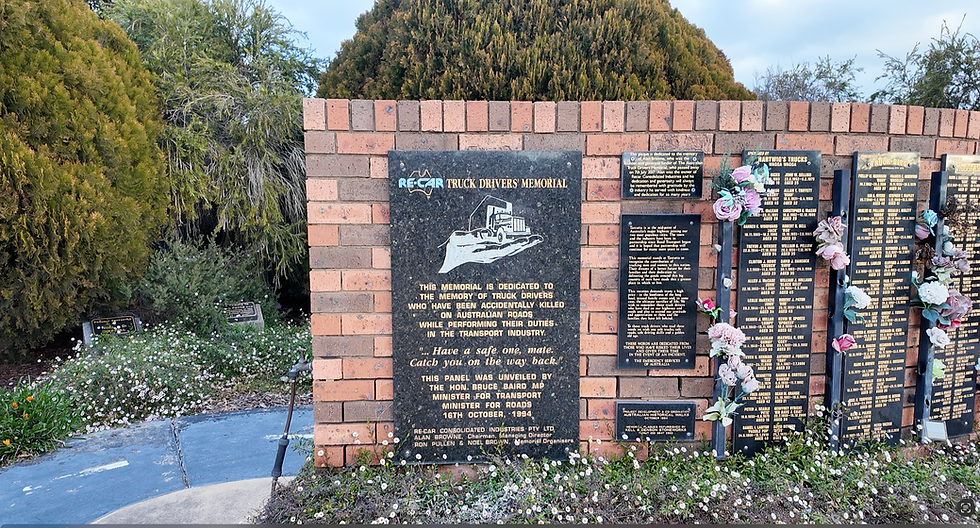
During the making of Shattered, we visited memorials around the country and spent time understanding the stories they told. Those visits brought a new awareness of how communities remember people, and how much can be held within a name, an inscription or a place.
Workplace memorials have a particular role in acknowledging lives lost through work. They give families and communities somewhere to remember, while keeping the human consequences of workplace harm visible.
That acknowledgement belongs alongside care for people living with serious injury and the families beside them. Their experiences of grief and loss may also need recognition: changes to health, livelihood, relationships and the future they had expected.
For workplaces, this opens a conversation about how we respond when someone’s life changes. Making space to listen, maintaining connection and acknowledging what has happened are practical ways to offer care.
At Hoskins Church, life continues to grow around the memorials. The flowers return, while the losses they mark remain.
Generations later, the names are still there. We can learn their stories, understand something of the lives behind Lithgow’s industrial history, and pause to remember those we love, too.


Comments