
Heyfield: Timber, Migration and the People Who Built a Town


Researching and filming Shattered has been a very humbling experience, mostly because we feel as though we really have traversed through Australia's rich work history and gotten to know the people who built our nation. Today we discuss Heyfield.
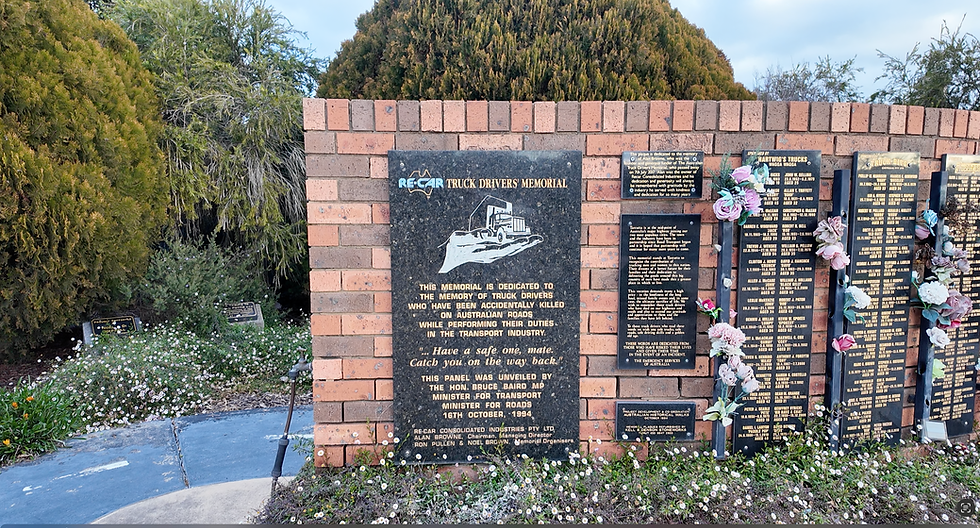
Heyfield's Victorian Timber Workers Memorial is a memorial shaped like shelter - situated in Lions Park at Heyfield, at the foothills of Victoria’s Great Dividing Range. The memorial honours the people who went to work in the timber industry and never came home.
Heyfield's Victorian Timber Workers Memorial does not take the form of a grand statue. At its centre is an iron structure resembling a timber worker’s mountain hut—a place of shelter, warmth and survival.
Inside, a fireplace evokes the places where workers once gathered at the end of a difficult day. Around it, plaques set into stone pillars carry the names of people killed while working in Victoria’s forests, logging coupes, sawmills and timber cartage.
When the memorial opened on 5 December 2015, it carried the names of 76 timber workers who had died across Victoria over more than a century. It was built so families would have somewhere to gather, remember and ensure those deaths were not absorbed silently into the history of an industry. Victorian Timber Workers Memorial
But the memorial tells another story too.
It stands beside Heyfield’s International Walk, commemorating the migrants who came to the district after the Second World War. The story of timber in Heyfield cannot be separated from the story of migration, displacement and the people who supplied the labour needed to build a growing regional town and who came to Australia to build a new life, a safe life.
A town transformed by work
Heyfield was not always known principally as a timber town. Timber had been milled locally during the nineteenth century, but the industry that came to define modern Heyfield developed rapidly from the 1950s.
After the forests burnt in the catastrophic 1939 bushfires had been logged elsewhere, eight companies were granted licences in 1950 to harvest mountain ash in the Macalister Forest District north of the town.
Seven sawmills were subsequently established in Heyfield, with another at Licola. For a time, Heyfield became one of Victoria’s largest timber-producing centres. Victoria’s Forestry Heritage
That growth depended on labour.
Before the mills expanded, the State Rivers and Water Supply Commission had begun major irrigation works around Heyfield and Glenmaggie. Hundreds of workers were employed constructing channels and drains and raising the Glenmaggie Weir wall. Among them were displaced people who had arrived in Australia following the devastation of the Second World War.
When the irrigation project was completed around 1960, approximately 60 of those families remained in the district. They became part of a town whose economic life was increasingly centred on timber. Victorian Places – Heyfield
Some arrived carrying little more than their capacity to work and the hope that Australia might offer safety and a future. They entered industries that were physically demanding and, at times, unforgiving. Language differences, unfamiliar machinery and limited power in the workplace could add further layers of vulnerability.
They established homes in the region, raised children, formed friendships and contributed their food, customs, skills and memories to the life of the district.

The risks carried home
Timber work required strength, judgement and constant attention. It was dangerous work too. Workers entered forests where falling branches, unstable trees, rolling logs and changing weather could turn routine work into catastrophe.
Drivers carried enormous loads along mountain roads. Inside the mills, people worked around saws, belts, rollers, heavy timber and powerful machinery.
An incident could happen in seconds. Its effects could last for generations.
When a timber worker was killed, the loss did not end at the forest boundary or mill gate. It travelled home to a partner, children, parents, friends and workmates. For migrant families, that loss could be compounded by distance from extended family, limited English, financial insecurity or unfamiliarity with Australian institutions.
The workplace fatality might be recorded under one person’s name, but its consequences spread through an entire family and community.
We have learnt a great deal about our workers by visiting these memorials and in towns around the country. They make visible what official statistics often cannot: the empty chair, the income that disappeared, the children raised without a parent and the workmates who returned to the same machinery carrying the knowledge of what had happened.
Two histories, standing together
The location of the Victorian Timber Workers Memorial beside the International Walk offers a powerful reading of Heyfield’s past.
One remembers workers who lost their lives.
The other acknowledges people who crossed oceans, survived war and displacement, and helped establish the community that Heyfield became.
Together, they remind us that industries are never built by machinery, licences or timber allocations alone. They are built by people. Often, they are built by newcomers prepared to take on difficult work while trying to establish a life in an unfamiliar country.
The migrant story also broadens how we think about workplace safety. A worker brings more than their labour to a job. They bring a family, a culture, a history and hopes for the future. When work causes serious injury or death, all of those connections are affected.
What a community chooses to remember
The Heyfield memorial was created through the combined efforts of local people, industry, government and Wellington Shire. Its designers, Holly Grace and Aaron Robinson, conceived the hut as both a place of contemplation and a symbol of protection and survival.
That choice is deeply fitting. It is a beautiful memorial.
A fitting memorial can create shelter for memory. It can give grief a recognised place within the community.
Most importantly, it can remind future generations that the prosperity of a town came at a human cost.
In Heyfield, the timber workers’ names remain close to the story of those who arrived from elsewhere and helped build a new community. The memorial and the migrant walk belong beside one another.
One tells us who was lost.
The other helps us understand who was there—and how much of the town they helped create. It also reminds us how important and valued migrants have been towards the building of our country.


Comments